Coverage positions that hold up, in hours.
The whole policy read against the claim, the three timing clocks tested, every finding cited — and the position drafted in hours. Broker advocates, carrier claims teams, and coverage counsel run the same read.
Coverage position — a claims-made D&O claim, the three clocks tested
Representative screen · specimen claimCoverage position
Reliance: Counsel review 2 of 3 clocks satisfied·1 withheldThe three clocksEach tested on its ownComplaint · p.1Demand ltr · p.2
1Claim first made during the policy periodRefer to coverage counsel
Ins. Agr. I.A · p.2Cond. VII.D · p.11May relate back to the 9/16/24 shareholder demand.
2Wrongful act on or after the retroactive dateSatisfied
Decl. Item 7 · p.1Def. II.R · p.4Q2 2022 10-Q is the first misstatement — after retro.
3Reported within the notice windowSatisfied
Cond. VI.A · p.10Reported 7 days after service, 187 days ahead of the post-period deadline.
Exclusions & conditions4 tested · NSP-DO 1000 §IV
Complex claims are decided on a reading, not a summary.
Which clause controls, whether a familiar term was quietly redefined, which of three timing questions the file actually turns on — per policy, since each claims-made form carries its own retroactive date. That reading takes a coverage attorney a day. Most claims get an hour.
Investigates coverage the way counsel does.
Grant, definitions, conditions, exclusions, then the endorsements that rewrite them — read whole and in order, with the three clocks tested per policy and one of eight verdicts named, including “refer to coverage counsel.”
Drafts the position in the policy’s own language.
Coverage position letters, reservations of rights, and the responses to them — every assertion cited to page and clause, at a reliance tier your counsel governs. The same read, from either side of the file.
Reads the loss run for the pattern.
A loss run or bordereau in; frequency against severity, causes of loss, deductible scenarios, and the executive summary out — computed and charted on Qumis’s own computer, every figure cited to the row.
“Would this let our team dig through the policy and apply the facts and circumstances to the policy language?”
Prospect, recorded call — the question every claims desk asks first
Yes. And the people who do that for a living are the heaviest users on the platform.
Qumis production data — a 30% power-user rate among claims professionals, the highest of any persona; 220 professionals at 48 organizations brought coverage-position work (denials, reservations of rights, responses) into Qumis in 180 days
The loss run, read for the pattern.
A loss run or a bordereau goes in. Qumis computes the statistics, draws the charts, and writes the executive summary — frequency against severity by policy year, incurred loss by cause, deductible scenarios — with every figure cited to the row. A dashboard, a deck, or a spreadsheet, in your brand.
Loss-run analysis — the request, the seven tasks, and the dashboard it produced
Production capture · specimen client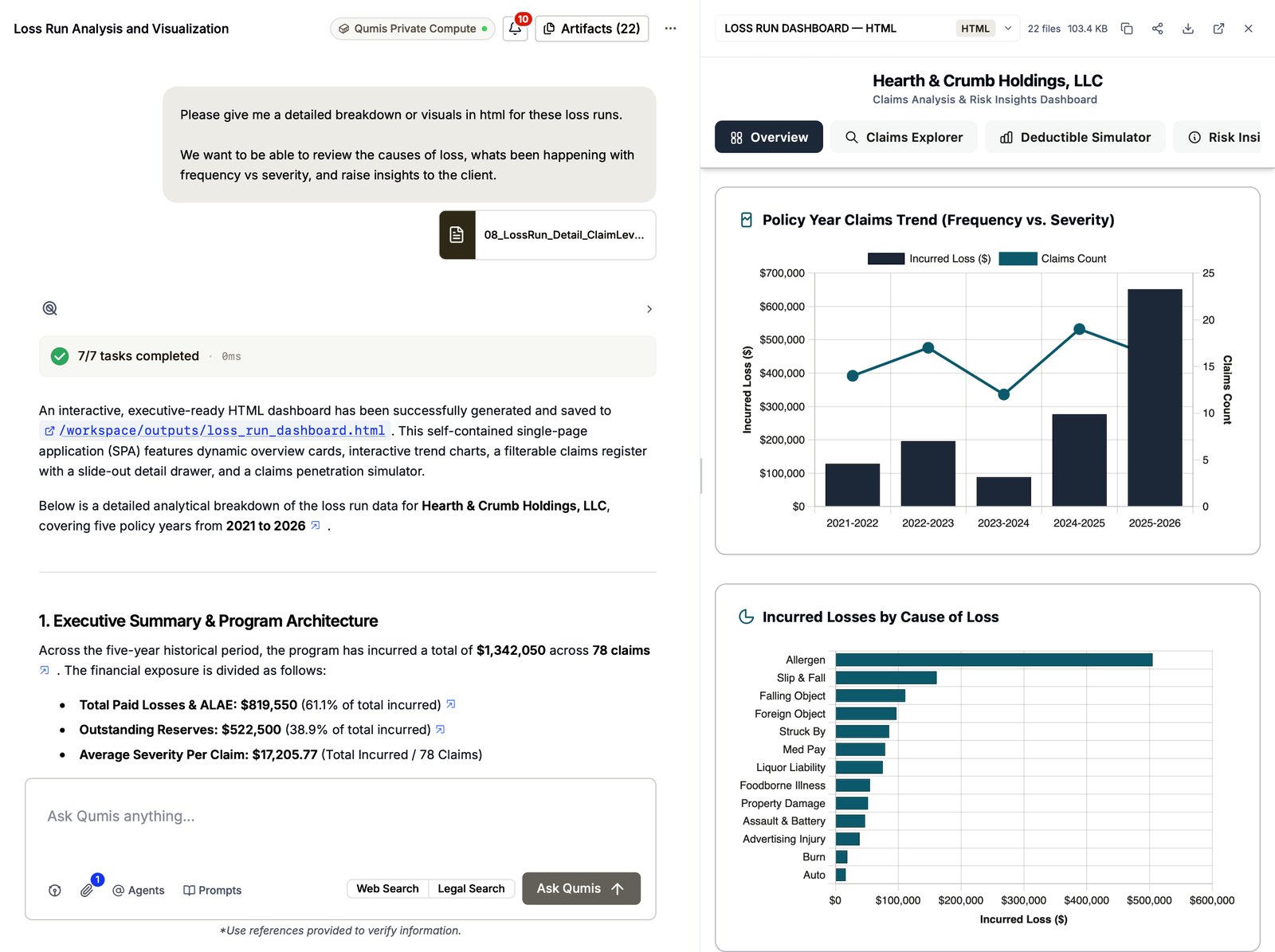
Frequency against severityPolicy-year claim counts against incurred loss — where the trend turned, and which years carried it.
Cause of lossIncurred loss by cause, ranked — the two categories driving the total, and the long tail behind them.
Deductible scenariosWhat a different deductible would have done to the same five years — simulated on the actual claims.
The most skeptical audience is the happiest one.
Claims professionals have the highest NPS of any persona on the platform — because the position arrives cited to the clause so a professional can check it, at the reliance tier their counsel set, and because it says “I don’t know” when the language is ambiguous.
+25NPS among claims professionals, against +11 across the platform.
Qumis production data, 180 days to August 2026. Exhibit: a representative coverage-position paragraph on a specimen claim.
Draft · tone: measured · every assertion cited
…the claim was first made on 12 May and reported on 22 June, within the period Condition IV.A requires. The March 2017 wrongful act falls after the policy’s 1 January 2015 retroactive date. Whether the 2016 demand letter constitutes a known circumstance under Exclusion III.F cannot be determined from the file as it stands; the application and the 2016 board minutes are requested before any position is taken on that ground.
Cond. IV.A · p. 14Decl. Item 6 · p. 1Excl. III.F · p. 9Teams that run claims here usually run these next.
The questions buyers ask first.
We’re a carrier claims team. Is Qumis built for the broker side?
It’s built for the coverage question. Qumis reads the policy and the file and reports what the language does — covered, excluded under a named provision, barred on a named clock, uncertain, or “refer to coverage counsel” — with the clause cited. Broker advocates, carrier claims teams, TPAs, and coverage counsel run the same analysis, and one question claims teams put to it is the mirror image: if we take this position, what are the strongest responses we should expect? The position each team takes is its own.
We already run general AI assistants. Why use Qumis on claims?
Run both — our largest customers do. A coverage position is not a summarization problem: it turns on which clause controls, whether a familiar term was quietly redefined, and three separate timing questions that each decide coverage differently — per policy, since every claims-made form in a program carries its own retroactive date. Qumis tests the clocks, names the verdict, cites the clause, and drafts at a reliance tier your counsel governs.
Our claims people won’t trust AI.
They are our heaviest users. Claims professionals have the highest power-user rate of any persona on the platform — because Qumis cites the clause so a professional can check it, and says “I don’t know” when the language is genuinely ambiguous.
Is this legal advice?
No. Qumis produces cited coverage analysis at reliance tiers; licensed professionals and counsel own every position. “Refer to coverage counsel” is a designed verdict, not a failure state.
What does the analytics half do?
Load a loss run or a bordereau and ask. Qumis computes the statistics and draws the charts on its own computer — frequency against severity by policy year, incurred loss by cause, a filterable claims register, deductible scenarios — and writes the executive summary with every figure cited back to the row. It comes out as an interactive dashboard, a deck, or a spreadsheet, in your brand, for the quarterly claims review or the renewal.
Underneath the six is Coverage Intelligence — the system of judgment Qumis is building for commercial insurance, where every reviewed decision makes the next one better.